
Essential SaaS Metrics: What You Should Track and Why


Consistent growth is absolutely critical for SaaS businesses. They need to have a complete view of this growth to identify areas for improvement and ensure proper use of resources. This requires tracking different metrics to improve results, measure performance, and align processes with your organisational objectives.
More than half of SaaS companies believe that customer retention cost is the critical metric to track. Still, there are even several important metrics that matter most in any SaaS business, particularly if you’re under the pressure of retaining customers and sustaining growth.
Understanding key SaaS growth metrics, such as churn rates, revenue churn, and customer lifetime value, can make a huge difference to your business. To ensure success, here are the essential SaaS metrics companies should be using.
1. Customer churn
The customer churn rate is the number of customers leaving your service every month. This metric is particularly vital for huge and established SaaS companies. For example, a company with a million customers can have a churn rate of 3%. This means they’re losing about 30,000 customers every month.

In this case, replacing that many customers every month can be quite impossible, making your businesses unsustainable. When looking at the annual figures, this churn rate is about 3%, meaning a company needs to replace about a third of its customer base to maintain their revenues. The bottom line is that the more customers you have, the more you need to invest in customer retention.
2. Revenue churn
This is the measure of the amount of revenue paid by customers leaving your service — lost revenue. Some SaaS companies pay more attention to revenue churn than customer churn as it reflects the overall health of their business.

If your contracts have the same length, such as 12 months, reporting lost revenue as an annual figure makes more sense. However, if you have a mix of different contract lengths, such as 3-month, 6-month, and 12-month, monthly reports provide a clear view of your revenue.
3. Customer lifetime value
Commonly abbreviated as CLV, LTV, or CLTV, the customer lifetime value is the average revenue a single customer generates for your businesses before churning. This metric assesses the financial value of each customer based on their subscriptions.
CLV is vital in making critical decisions about marketing, sales, customer support, and product improvement. It’s also essential in identifying your best customers, and this allows you to come up with ways of improving your offering to suit their unique needs. More importantly, CLV helps you identify customers that your sales team should spend the most time on.

4. Customer acquisition cost
Customer acquisition cost (CAC) is the amount you spend to acquire a single new customer. You need to look at the total cost of marketing and sales over a given period to compute your CAC. Salaries and other headcount expenses, such as customer onboarding and nurturing costs, should also be included in the figure. Then, divide the amount by the number of customers you have.
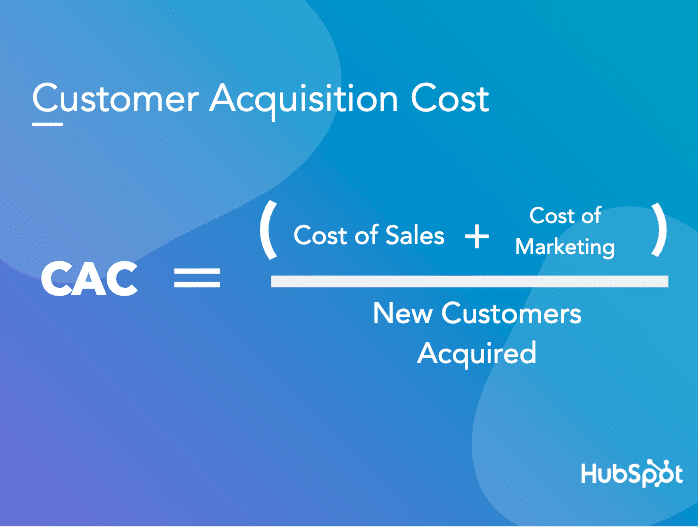
Tracking this metric is key to improving your SaaS customer acquisition process. It helps you identify ways of:
- Reducing the overall sales cycle
- Increasing the annual contract value
- Improving your sales & marketing efforts
- Reducing your customer churn rate
Keep in mind that acquiring new clients is five to 25 times costly than retaining your existing customers. So, tracking CAC is vital in finding ways of reducing it.
5. CAC payback period
CAC payback period is the time it takes for a single customer to pay back their customer acquisition cost. This period depends on how much the customer is spending monthly or annually and how high their CAC was.

A new customer only starts becoming profitable once their lifetime value exceeds their CAC. Therefore, the shorter the payback period, the better. Identifying opportunities for cross-selling and upselling is one of the effective ways of reducing the payback period for your customers.
6. Customer engagement score
At its core, this metric measures how engaged your customers are. Bear in mind that each customer has their own unique experiences with your product or services, so their engagement score will be different. Generally, the higher the score, the better.

Several inputs are vital in calculating this score, including depth of usage, frequency of usage, key performance indicators, and the specific actions taken. These inputs give you a clear view of your customer’s success, health, and engagement. The customer engagement score is vital in identifying problems, improving customer support, and delivering tailored services.
Struggling to Analyse Your Customer Engagement?
Download this FREE checklist to help you upgrade your tools and channels to better measure results, as well as a new framework for marketing campaigns. 💪
7. Qualified marketing traffic
While a SaaS company can get lots of website traffic, not all the traffic is valuable to the company. Therefore, qualified marketing traffic is the amount of traffic or leads that have expressed interest in your services or products. It’s easier to convert such customers into your buying customers when you identify them.

Keep in mind that improved traffic doesn’t necessarily mean improved conversions. SaaS companies need to use highly targeted keywords to attract qualified marketing traffic. More qualified traffic can result in less customer acquisition cost. Leveraging marketing strategies, such as search engine optimisation (SEO) and conversion rate optimisation (CRO), helps in delivering qualified leads.
8. Leads by lifecycle stage
Leads by lifecycle stage is basically the number of contacts or customers at the different stages of your marketing and sales processes. A typical lifecycle can have different stages, including:

- Visitor – any contact that visits your website or landing page
- Subscriber – a contact that visits your website and signs up for your newsletter or blog
- Lead – a contact that has gone beyond the newsletter signup by contacting your team
- Qualified lead – a contact that has been identified as a potential customer
- Opportunity – the key contact in a particular deal, always the decision-maker
- Customer – a contact that is already using your service
- Evangelist – a customer that’s advocating for your services or products
Categorising your contacts by lifecycle stage helps your sales teams to create effective targeting strategies to improve your conversion rate. This results in streamlined processes and reduced cost of acquisition.
9. Lead-to-Conversion rate
Also known as lead conversion rate or sales conversion rate, lead-to-conversation rate is the number of qualified leads that convert into buying customers. This metric is a key performance indicator (KPI) of your sales team and strategies.

About 90 per cent of customers who sign up for free trials don’t convert into actual customers. This means that most companies have a conversion rate of less than 10 per cent. However, the rate is not fixed, and it mostly depends on your sales efforts. For example, if you had 100 leads in November and only 15 converted into customers, then your conversion rate was 15 per cent in November.
Struggling to increase your conversion rate? 📈
Book in your FREE one-to-one session with one of our Growth Experts. We’ll assess your current sales strategy and layout actionable steps for you to get prospects moving down the sales funnel.
10. Customer health score
Your customer health score basically is a measure of your customer satisfaction. It reflects your customer’s relationship and engagement with your brand as well as the likelihood of them dropping your service (churn). This score takes into account several factors, such as:

- Community participation
- Account activity
- Customer feedback
- Product usage
- Product renewals and upgrades
You can use colour-coding to measure your customer’s profile health, such as green, yellow, and red. In this case, green represents a healthy score, while red means poor health or score. This score is vital in determining the pain points of individual customers, allowing you to provide personalised services that address their specific needs.
Key takeaways
SaaS metrics provide valuable insights into your sales performance, profitability, and customer satisfaction. They help you identify areas of your business that are performing well and those that are performing poorly. This information is vital in shaping the future growth and profitability of your SaaS company.
The problem is, many companies track the wrong metrics, resulting in an unclear and confusing picture of their business. We’ve covered the essential SaaS metrics you should track in this post to help you get a clear view of your business operations. If you’re looking to grow your SaaS business, be sure to book your free growth assessment with us.
Reach Your Revenue Goals. Grow MRR with Gripped.
Discover how Gripped can help drive more trial sign-ups, secure quality demos with decision makers and maximise your marketing budget.
Here's what you'll get:
- Helpful advice and guidance
- No sales pitches or nonsense
- No obligations or commitments





Book your free digital marketing review
 30 min session
Other Articles you maybe interested in

SaaS CAC Payback Period: Benchmarks and How to Improve
Master the SaaS CAC payback period with benchmarks and how to improve your efficiency to reinvest in growth and avoid cash-flow crises as you scale to £20M.

B2B SaaS CAC Benchmarks by Industry 2026
Compare your costs against current B2B SaaS CAC benchmarks by industry in 2025 to optimize your marketing spend and scale your ARR more efficiently.

How to Calculate SaaS Marketing ROI: A Step-by-Step Guide
Learn how to calculate SaaS marketing ROI with a step-by-step guide that uncovers hidden costs and ensures your revenue attribution is actually accurate.